The Complete Guide to Polymarket LP Farming and Liquidity Rewards
Learn how Polymarket LP farming works, how rewards and epochs are structured, and how Bravado automates liquidity provision with composite risk scoring and auto-replace.
Polymarket has over 3.1 million wallets. Only around 52,000 of them have ever provided liquidity.
That gap is the opportunity. The yield from Polymarket LP farming is real. Polymarket distributed $12 million in liquidity provider rewards in 2025 alone. The competition for those rewards is a fraction of the trading population. And the tooling to farm systematically, until now, has not existed for most participants.
This post covers exactly how Polymarket LP farming works, how the epoch and reward structure is designed, what the risks are, and how Bravado's LP farming tools automate the entire process.
What Is LP Farming on Polymarket?
Liquidity provision on Polymarket works differently from LP farming on DeFi protocols like Uniswap or Curve. There is no smart contract pool you deposit into. Instead, you provide liquidity by placing active limit orders on both sides of a market, buying YES tokens and NO tokens near the current midpoint price. You are functioning as a market maker, posting orders that other traders fill.
In exchange for that service, Polymarket distributes rewards to LPs based on how much liquidity they post, how close their orders are to the midpoint, and how consistently they maintain that liquidity over time.

The reward mechanism uses a quadratic spread function. This means posting quotes close to the midpoint earns disproportionately more than posting them further away. The platform is explicitly rewarding LPs who show up at the riskiest, most informative part of the book where trades actually happen, not LPs parking orders far from the action to collect passive rewards with minimal exposure. The closer your quotes are to the adjusted midpoint, the higher your reward multiplier.
The practical result is that serious LP farming on Polymarket requires active engagement. You need to be close to the midpoint, maintain consistent presence, and replace orders as they fill. That is where the yield lives, and that is exactly what Bravado automates.
How the Epoch and Reward Structure Works
Polymarket distributes LP rewards in 7-day epochs. At the start of each epoch, Polymarket designates a pool of USDC rewards across a selection of qualifying markets. The first epoch distributed approximately 50,000 USDC and 10,000 UMA to participants. In 2025, the total LP reward pool reached $12 million across all epochs.
How rewards are calculated within an epoch
Rewards are calculated per block on the Polygon blockchain. At each block, your share of the total reward available for a market is determined by your proportional contribution to total liquidity in that market at that moment. If you hold 10% of the qualifying liquidity in a market at a given block, you earn 10% of that block's reward allocation for that market.
This structure rewards consistency. LPs who maintain continuous liquidity presence across the full epoch earn more than those who post orders intermittently. Gaps in your liquidity, whether from filled orders that are not replaced or from manual withdrawal, reduce your block-by-block share.
Two distinct reward streams
The first stream is LP rewards, earned by placing qualifying limit orders within the maximum allowed spread in Polymarket-designated incentivized markets. Not every market is incentivized in a given epoch. Polymarket selects specific markets based on their strategic importance and liquidity needs.
The second stream is fee rebates. In high-frequency markets, specifically the 15-minute crypto outcome markets Polymarket introduced in 2025, the platform charges taker fees that scale dynamically with market uncertainty. These fees peak at around 3% when a market is near 50/50 probability, declining as outcomes become more certain. The taker fees collected are redistributed daily to liquidity providers in those markets as USDC rebates. This creates a second yield layer that sits on top of the standard LP reward pool.
Trades with an average price above 98 cents do not qualify for trading rewards, and Polymarket reserves the right to disqualify wash trading from reward distributions.
What the numbers look like
The yield available from LP farming has evolved as more participants have entered. In the early days of Polymarket's rewards program, open-source LPs reported returns of 200 to 300 USDC per day on roughly 10,000 USDC of capital at peak periods. As the program has matured and more sophisticated participants have entered, rewards have become more competitive. The current environment rewards LPs who combine smart market selection with tight, consistent quoting rather than those simply deploying capital broadly.
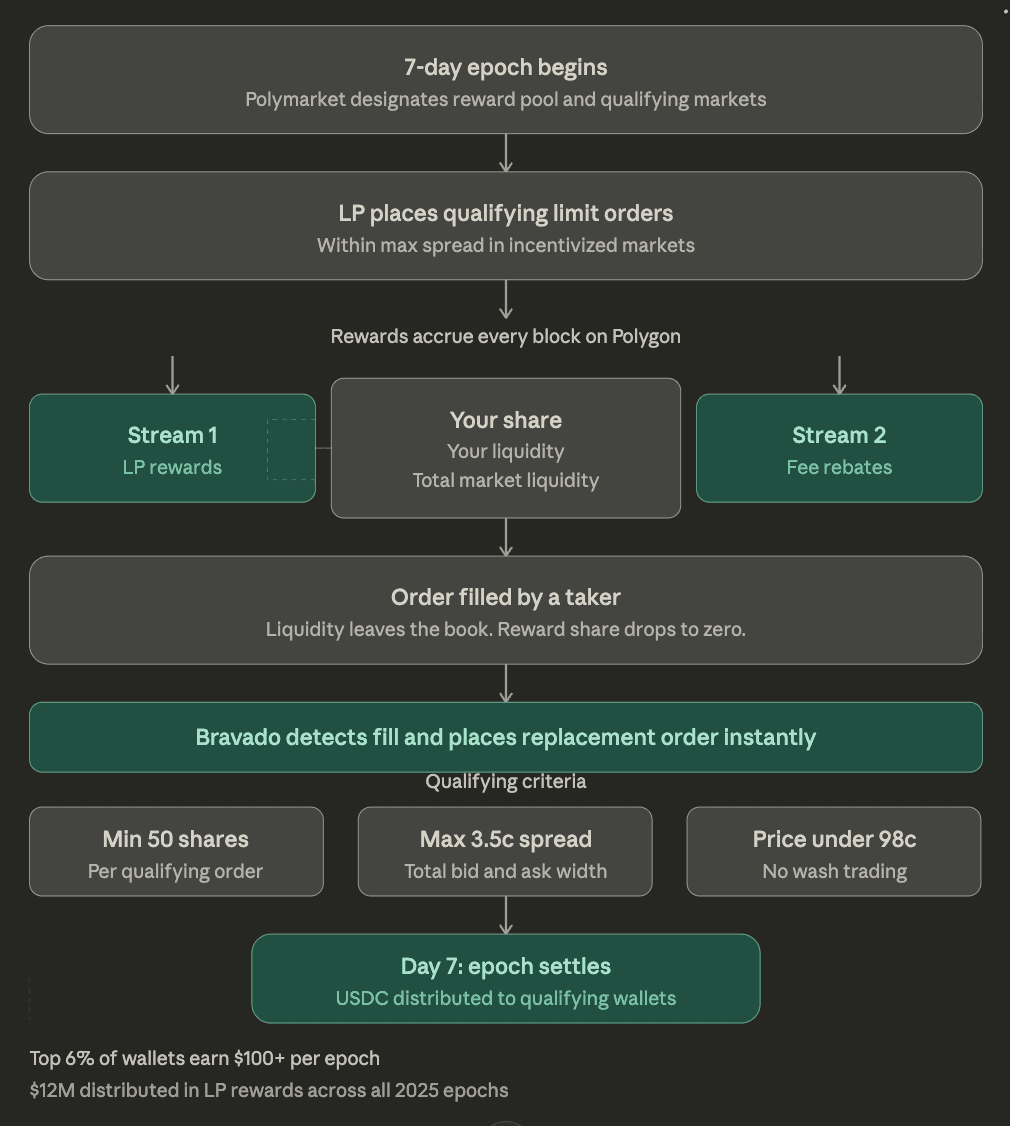
Earning $100 or more in cumulative LP rewards puts you in the top 6% of all Polymarket wallets. Earning $650 or more places you in the top 1,000 wallets on the platform. Given that only 52,000 wallets have ever farmed at all out of 3.1 million total, the absolute competition level remains low relative to the reward pool.
The Risk Profile of LP Farming on Polymarket
LP farming on Polymarket carries a risk profile that DeFi-native participants will recognize but should not assume is identical to impermanent loss on an AMM.
The core risk is directional price movement. When you provide liquidity to a Polymarket market, you are posting orders on both the YES and NO sides. If the market moves significantly in one direction before you can update or withdraw your positions, the outcome tokens you hold can lose substantial value.

The official Polymarket documentation illustrates this clearly. If you add $100 USDC to a liquidity pool when YES is priced at $0.90 and NO at $0.10, a sudden shift in YES pricing to $0.50 would reduce your YES token holdings to approximately $50 in value, a 40% loss on that portion of your position. This is not a theoretical edge case. Prediction markets can gap significantly on breaking news, unexpected announcements, or approaching resolution dates.
The practical risk management framework for LP farming follows from this reality.
Markets with stable, well-established probabilities that have been range-bound for weeks are better LP environments than markets that are actively moving. Long-dated markets with resolution dates weeks or months away give you more time to respond to price shifts than markets resolving in the next 24 to 48 hours, where probability movement accelerates sharply.
Lower liquidity markets present a higher risk and higher reward profile. A position in a thin market has more price impact on both entry and exit, but also captures more of the available fee flow given the smaller total liquidity competing for rewards. This is a deliberate trade-off, not a design flaw.
Understanding your risk-adjusted yield, rather than chasing the highest nominal rewards, is what separates systematic LP farming from capital-at-risk speculation.
How to Select the Right Markets for LP Farming
Market selection is where most of the LP farming edge is made or lost. The reward pool distribution across markets changes each epoch, and not every incentivized market represents a good risk-adjusted opportunity.
Market depth is the starting point. Deeper markets are safer environments for LP farming but offer lower yields per dollar deployed because more capital is competing for the same reward pool. Thinner markets carry higher directional risk but offer higher yields for those willing to manage that risk actively.
Time to resolution is the most important risk filter. A market resolving in 72 hours is a fundamentally different LP environment than one resolving in 60 days. As a market approaches resolution, probability estimates converge toward 0 or 1, and the speed of that convergence can be sudden. Avoid markets in the final days before resolution unless you are actively monitoring positions and prepared to exit quickly.
Current spread signals the level of LP competition. A wide spread in an incentivized market means there is room to earn by posting tighter quotes. A market where the spread is already tight from active LP competition offers less room to differentiate and may not be worth the capital deployment given the available rewards.
Historical volume tells you how actively the market is being traded. High volume markets generate more taker activity, which means more fee generation and more reward distribution. Volume and reward pool size together determine the effective yield per unit of liquidity deployed.
Category considerations matter at the portfolio level. Political markets with stable long-range probabilities have historically been among the best LP environments on Polymarket. Sports markets, particularly those resolving on a specific game outcome, carry higher short-term movement risk as they respond to injury news, lineup changes, and in-game developments.
How Bravado Automates Polymarket LP Farming
The manual reality of LP farming without tooling is that it is essentially a second job. Monitoring every position across every incentivized market, replacing filled orders before your reward share drops, reassessing risk as markets move, tracking epoch rewards across multiple positions simultaneously. Most participants who attempt it manually either underperform or burn out.

Bravado's LP farming tools are built specifically to eliminate that friction.
Order templates: Conservative, Balanced, and Aggressive
The first decision any LP has to make is how to distribute their capital across spread levels. Posting everything at a single price is suboptimal. Professional market makers spread their orders across multiple price levels to balance fill probability against reward multiplier. Bravado builds that logic into three ready-to-deploy templates.
The Conservative template allocates 20% of capital at 1c from mid, 30% at 2c, and 50% at 3c. It prioritizes capital protection. Your orders sit further from the midpoint, reducing fill risk while still qualifying for rewards.
The Balanced template splits capital evenly: 33% at 1c, 33% at 2c, and 34% at 3c. It is the default starting point for most markets, balancing yield against directional exposure.
The Aggressive template flips the weighting, putting 50% at 0.5c from mid, 30% at 1c, and 20% at 1.5c. It maximizes your quadratic reward multiplier by concentrating liquidity as close to the midpoint as possible. Higher yield, higher fill risk. Best suited to stable, high-conviction markets.
Each template generates a full order ladder, placing both bid and ask orders at each level simultaneously. For a 50-share minimum position, this produces 6 orders per cycle: 3 bids and 3 asks, each sized and priced according to the template allocation.

You can also control spread width manually with a slider from tighter (more fills, higher reward multiplier) to wider (safer, fewer fills). The live order ladder updates in real time as you adjust so you see exactly what will be placed before committing.
Auto-rebalancing and automatic order replacement
The most important automation in Bravado's LP farming product is what happens when one of your orders gets filled.
On Polymarket, a filled order means your liquidity has left the book. Every block you are absent from the book is a block you are not earning rewards. Without tooling, noticing a fill and manually replacing the order introduces a gap. Over the course of an epoch, those gaps compound directly into lost rewards.
Bravado monitors your positions in real time. The moment an order is executed, whether a bid or ask, it automatically places a replacement order at the same price level and size according to your active template. Your presence in the book is restored immediately, with no manual step and no gap in reward accrual.

For markets where the underlying probability has moved since your last cycle, Bravado's re-apply functionality recalculates the appropriate order prices relative to the new midpoint and places a fresh full ladder. You are always quoting around the current market price, not a stale one from when you first deployed.
Dashboard: total deployed, daily rewards, and blended APY
Bravado's LP dashboard gives you a single view across all your active farming positions. You can see total capital deployed, estimated daily rewards across all positions, and blended APY across your full LP portfolio in real time.
Each individual position shows your YES and NO bid and ask levels, distance from the current midpoint, and daily reward estimate. Positions sorted by fill risk let you see at a glance which markets are closest to moving against you so you can act before a fill turns into a directional loss.
Composite risk scoring and market filters
Rather than requiring you to manually evaluate each market, Bravado calculates a composite score for every active market by combining volatility, time to resolution, current spread, historical volume, and liquidity depth. Each market gets a ranked score so you can identify the best risk-adjusted LP opportunities in the current epoch without running the analysis yourself.
Filter the full market list by risk score, category, time to resolution, and current spread. Build your LP portfolio around the markets that match your risk tolerance in minutes rather than hours.
The combination of templates, auto-replacement, re-apply, and risk scoring means LP farming, which previously required the attention of a professional market maker to do well, becomes a systematic strategy any serious Polymarket participant can run alongside their directional trading activity.
Bravado is part of a broader Polymarket trading terminal that includes advanced order types, copy trading, real time alerts, and whale tracking. LP farming is one layer of a vertically integrated platform built for every type of serious Polymarket participant.
Who Polymarket LP Farming Is For
DeFi natives who already provide liquidity on Uniswap, Curve, or similar protocols will find the yield optimization mindset directly transferable. The mechanics are different but the core question is the same: where is my capital generating the best risk-adjusted return right now. Bravado answers that question for Polymarket specifically.
Active Polymarket traders who carry a capital reserve between positions have an obvious use case. Rather than holding idle USDC between directional trades, deploy it into LP farming in stable, long-dated markets. Your capital earns while it waits.
Passive yield seekers who want exposure to prediction market returns without taking directional views on outcomes find in LP farming a strategy that does not require a position on any specific outcome. Your yield comes from the activity of other traders, not from your own predictions being correct.
And for anyone thinking carefully about their Polymarket activity profile ahead of any potential future token distribution, LP farming is worth noting specifically. Only 52,000 wallets out of more than 3.1 million have ever provided liquidity. That is an unusually strong signal of platform engagement and contribution to market health.
Start LP Farming on Bravado
Bravado's LP farming tools give you composite risk scoring, auto-replace, epoch tracking, and market filters in a single platform built exclusively for Polymarket.
Start LP farming at app.bravadotrade.com/lp-rewards
Or explore the full terminal at app.bravadotrade.com.
Follow us on X for product updates, farming strategies, and market insights: @bravadotrade
Read more blogs
Trading insights, market analysis, and strategies for Polymarket prediction markets.