Polymarket Taxes: The Complete Guide to Reporting
Polymarket taxes explained: what's taxable, how the IRS treats prediction market income in 2026, and how to generate a free on-chain tax report for your wallet.

If you traded on Polymarket this year, the IRS wants a number from you whether or not Polymarket ever sends you a form. That surprises a lot of traders, because Polymarket doesn't issue 1099s, doesn't withhold anything, and settles everything in USDC on Polygon instead of through a broker. None of that changes your reporting obligation. This guide walks through what's actually taxable, why the classification question is still unsettled, and how to turn your wallet history into a number you or your accountant can file with confidence.
The Quick Answer
Every dollar of profit you make trading on Polymarket is taxable income in the US, regardless of whether you ever withdraw it to a bank account. Selling a position or having a market resolve is the taxable event, not the moment you cash out. That's the single most common misconception among prediction market traders, and it's the one that gets people in trouble during an audit.
What's genuinely unresolved is how that income gets classified. The IRS has never published formal guidance naming which tax category prediction market contracts fall into, so tax professionals currently work from one of three approaches: capital gains, gambling income, or Section 1256 contract treatment. Which one applies to you can meaningfully change your tax bill, especially if you had losing trades.
Taxable Events: What Actually Triggers a Bill
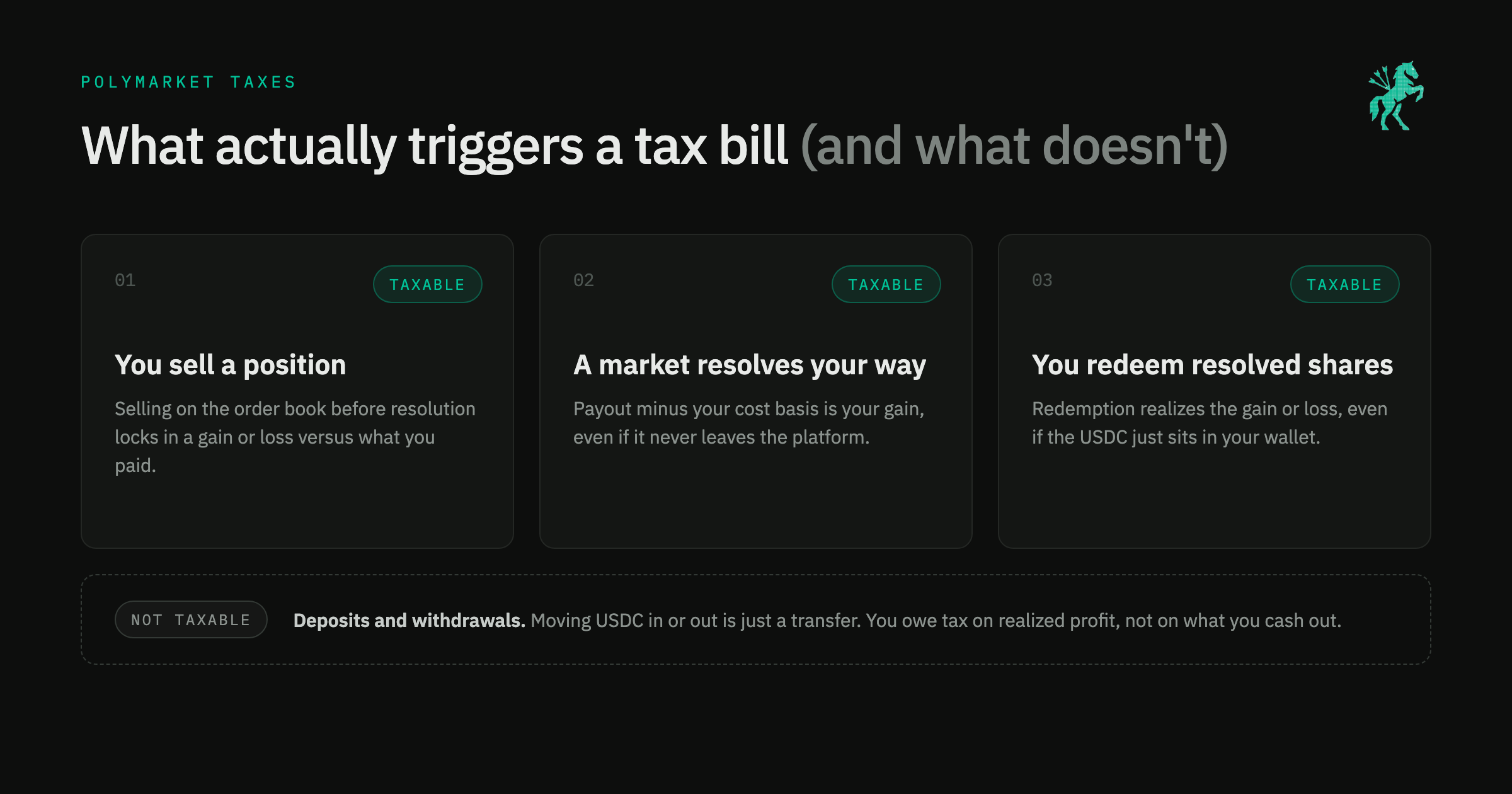
Three things create a taxable event on Polymarket:
Selling a position on the order book before resolution, at a gain or loss versus what you paid.
A market resolving in your favor, where the payout versus your cost basis is your gain.
Redeeming resolved shares, which locks in the realized gain or loss even if you leave the proceeds sitting in your wallet.
Depositing and withdrawing USDC are not themselves taxable events; they're just transfers. But because withdrawals often get confused with "cashing out profit," a lot of traders wrongly assume they only owe tax on what actually leaves the platform. If you never withdrew a dollar but resolved winning positions all year, you still have a tax bill.
Why Classification Is Still a Live Debate
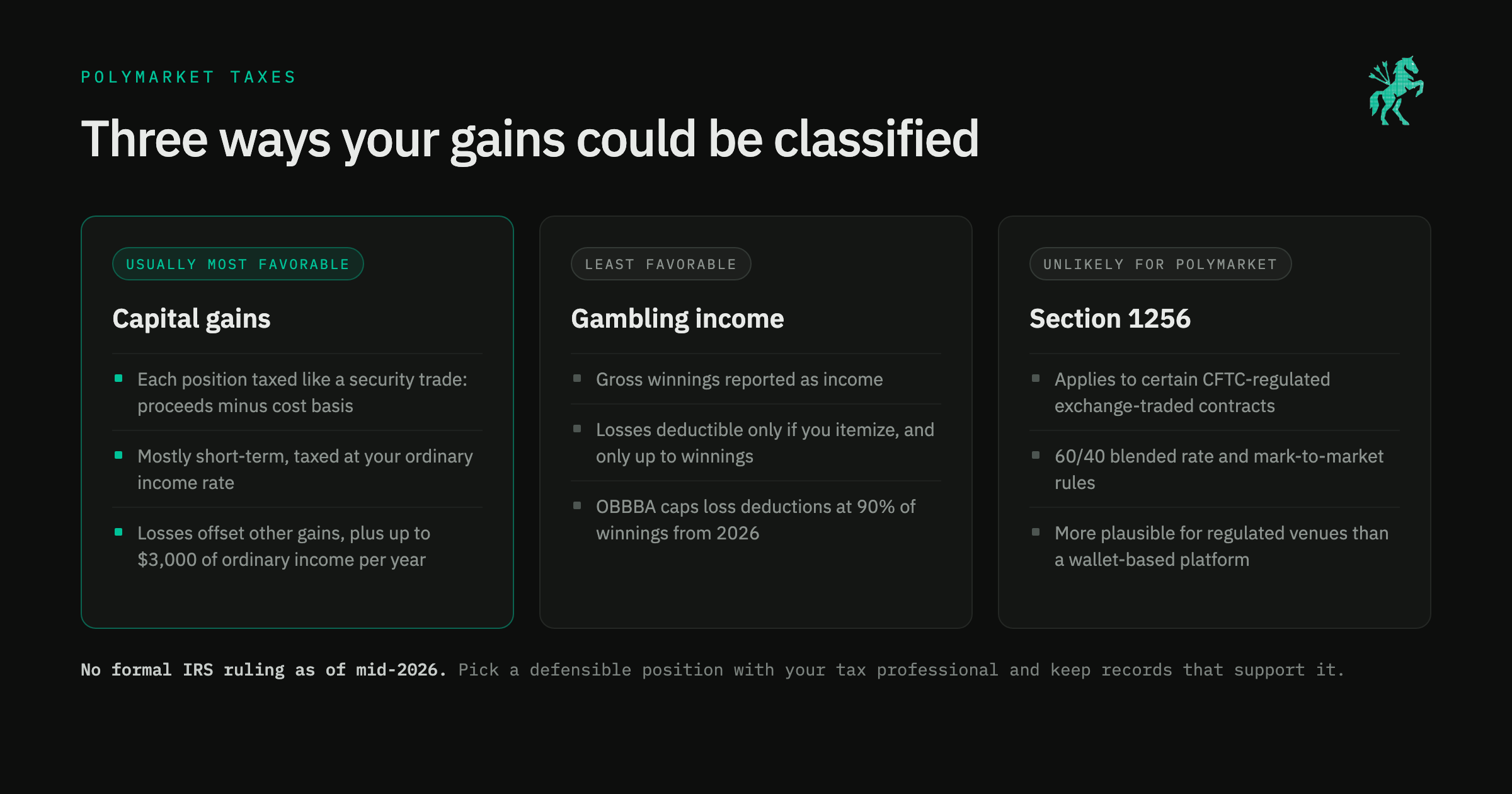
Polymarket doesn't fit neatly into an existing IRS category, and as of mid-2026 no revenue ruling, notice, or regulation has settled the question directly. That leaves three competing frameworks in play:
Capital gains treatment treats each position like a security trade: cost basis in, proceeds out, gain or loss on the difference. Since almost no Polymarket position is held longer than a year, this typically means short-term capital gains taxed at your ordinary income rate. Under this framework, losses can offset other capital gains dollar-for-dollar, plus up to $3,000 of ordinary income annually.
Gambling income treatment requires reporting gross winnings as income, with losses deductible only if you itemize, and only up to your winnings. This is the least favorable treatment for active traders, because the standard deduction (which most filers take) leaves no room to deduct losses at all, so you'd owe tax on gross winnings rather than net profit.
Section 1256 contract treatment, which applies to certain CFTC-regulated exchange-traded contracts, comes with its own 60/40 blended rate and mark-to-market rules. This is more likely to apply to regulated venues than to Polymarket's original wallet-based platform.
A further wrinkle: recent tax law (OBBBA) caps gambling-loss deductions at 90% of winnings for tax years beginning in 2026, which makes the classification question even more consequential if your activity gets treated as gambling. Given the uncertainty, the safest posture is to pick a defensible position with your tax professional, document it, and keep records precise enough to support it either way.
Cost Basis, FIFO, and What Your Records Need to Show
Whichever classification applies, the underlying math is the same: proceeds minus cost basis equals gain or loss. Lots are generally matched first-in-first-out (FIFO), the standard default US filers use absent a specific election. Fees paid to open a position get capitalized into your cost basis, and fees paid to close one get netted out of your proceeds.
To actually reconstruct this, you need, per market and per transaction:
Every fill, at what price, and when
Every resolution and its settlement value ($1.00 or $0.00 per share)
Every redemption
Realized gains on closed positions, plus mark-to-market value on anything still open at year end
None of this comes from a 1099, because Polymarket doesn't issue one. The platform is offshore and blockchain-based, and doesn't collect the information a broker normally would. That means the record-keeping burden sits entirely with you. The IRS can audit returns going back several years, so "I'll figure it out if they ask" is a bad plan.
How to Actually Generate the Numbers
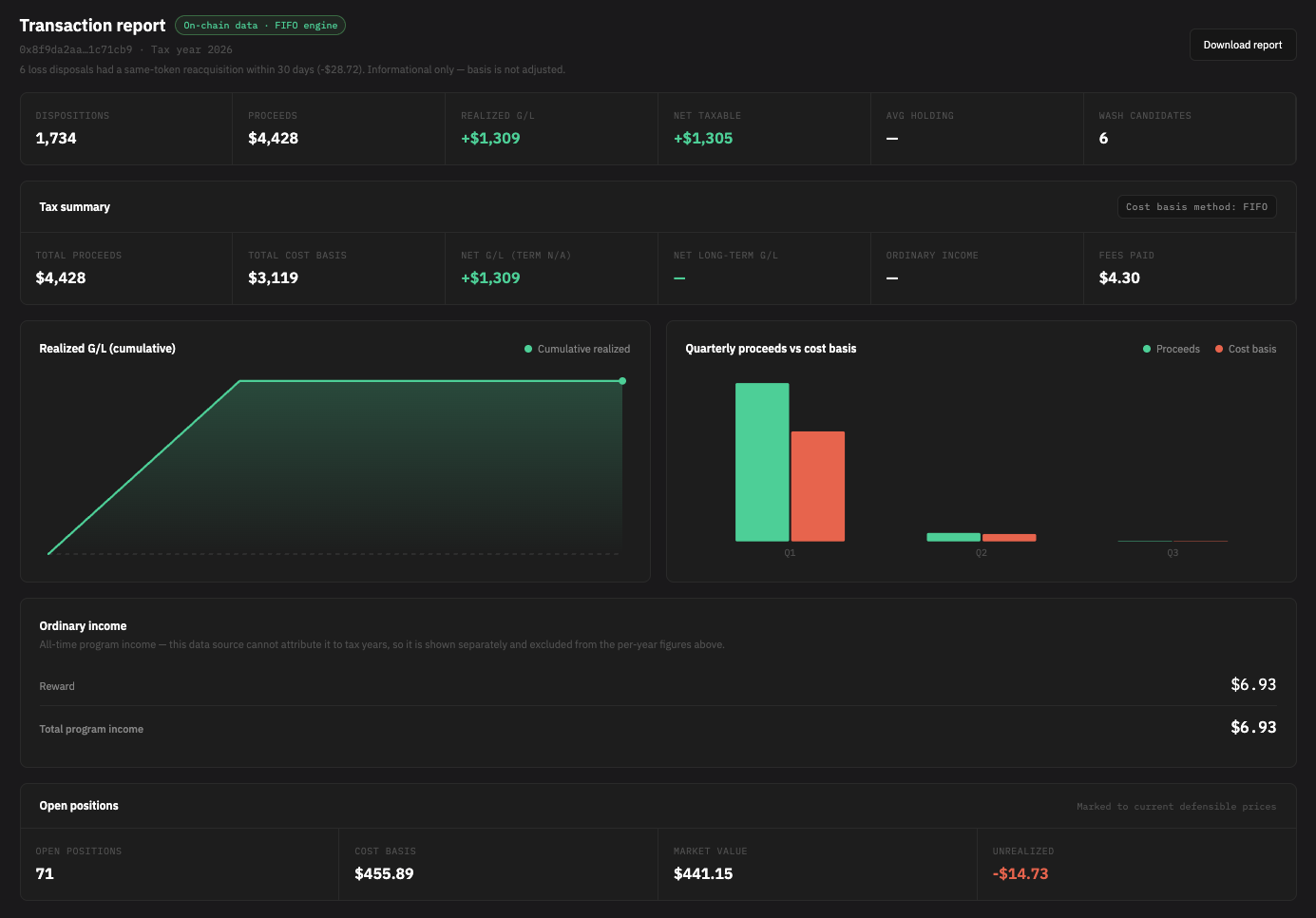
Manually reconstructing a year of Polymarket activity from a block explorer is exactly the kind of task nobody wants to do in April. Bravado's free tax report tool does this reconstruction for you: paste any Polymarket wallet address and it rebuilds your complete transaction history directly from on-chain data (every trade, resolution, and redemption) with realized PnL, mark-to-market valuation on open positions, and a per-market breakdown of cost basis and proceeds using FIFO matching.
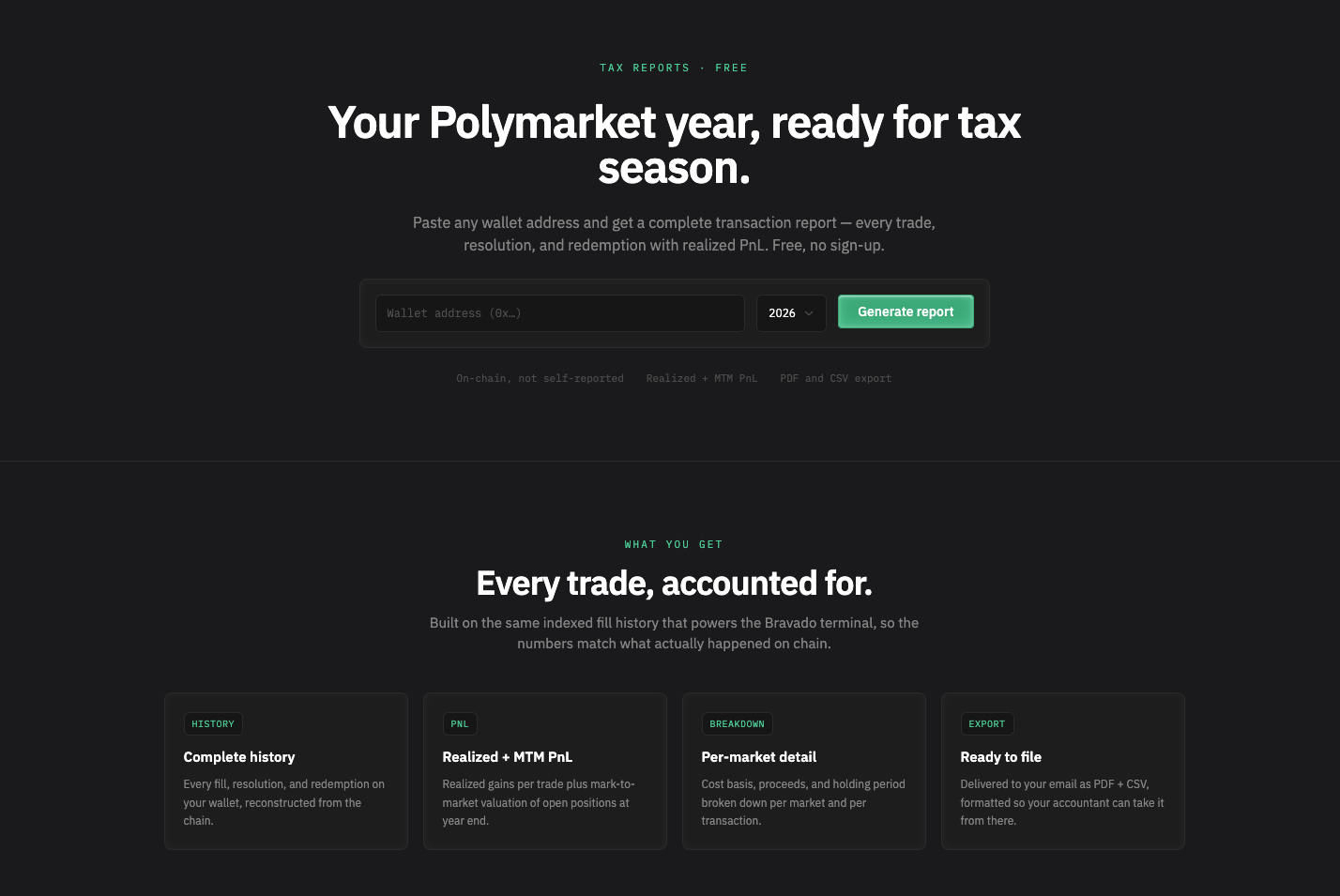
It's free, requires no sign-up, and never asks for a wallet connection or private keys. It's built entirely from public on-chain data. Reports are formatted so an accountant can pick them up directly, whether that ends up mapping to Schedule D, Schedule 1, or wherever your classification approach lands you. If you run multiple wallets, or you're a fund or prop desk with reporting obligations across several addresses, you can run a report per wallet and keep every book tied back to on-chain truth instead of platform screenshots.
Frequently Asked Questions
Do I owe taxes on Polymarket winnings if I never got a 1099? Yes. Polymarket doesn't issue 1099s, but the absence of a form doesn't remove your reporting obligation. All income is reportable regardless of third-party reporting.
Am I only taxed on what I withdraw? No. Selling a position or having a market resolve is the taxable event, even if the proceeds never leave Polymarket. Withdrawals are just transfers.
Are Polymarket gains treated as gambling income or capital gains? It depends which classification you and your tax professional adopt; there's no official IRS ruling naming one. Capital gains treatment is generally more favorable for active traders with losses, since gambling treatment restricts loss deductions to itemizers and, as of 2026, caps them at 90% of winnings.
What cost basis method should I use? FIFO (first-in-first-out) is the standard default for US filers absent a specific election. Opening fees are capitalized into basis; closing fees are netted from proceeds.
Can I deduct my losses? Under capital gains treatment, losses offset other capital gains dollar-for-dollar plus up to $3,000 of ordinary income per year. Under gambling treatment, losses are deductible only if you itemize, only up to your winnings, and only up to 90% of those losses under current law.
Is a Bravado tax report the same as tax advice? No. The report gives you and your accountant accurate, on-chain-verified data to work from: cost basis, proceeds, and PnL by transaction. It isn't a substitute for advice from a qualified tax professional, and you should consult one before filing.
Get Your Numbers Before Tax Season Hits
Whichever classification you and your accountant land on, everything downstream depends on having a complete, accurate transaction history first. Generate a free Polymarket tax report built directly from on-chain data, and hand your accountant something they can actually work from instead of a wallet address and a headache.
This article is general information, not tax advice. Prediction market tax classification remains an active, unsettled area as of mid-2026. Consult a qualified tax professional about your specific situation before filing.