Polymarket WebSocket Freezes: What Breaks and Why Teams Use Bravado
Polymarket WebSockets can go silent without closing. What we measured over 32 hours, what a DIY fix takes, and how Bravado manages the connection layer.
If you build on Polymarket's real-time feeds, at some point your WebSocket will stay open, keep accepting your pings, and stop sending you data. Nothing raises an error. Your bot just stops seeing trades, and your dashboard shows a market that looks quiet when it isn't.
This post covers what actually breaks on Polymarket's two public WebSockets, using 32 hours of measurements on 20 markets, and what it takes to handle it yourself. It also covers how Bravado's managed WebSocket deals with the connection layer, and where you still need your own safeguards.
Which Polymarket WebSockets are there?
Polymarket has two public streams that developers use for live market data. They run on different hosts, use different message formats, and need different keepalives.
CLOB market channel | RTDS (Real-Time Data Socket) | |
|---|---|---|
Endpoint |
|
|
Subscribe |
|
|
Scope | The outcome tokens you list |
|
Messages |
|
|
Keepalive | Text | Text |
Both are documented in Polymarket's real-time data docs. Price topics are moving from RTDS to PolyBolt (wss://ws-live-v2.polymarket.com/ws). The activity trade topic stays on RTDS, according to the migration page.
What is a Polymarket WebSocket freeze?
A freeze is a socket that is still open (no close frame, no error) but delivers no data while trades are happening. A disconnect is easy: your library sees it and reconnects. A freeze is the expensive case, because most clients wait forever for a close that never comes.
Three things make freezes hard to catch:
The server stops sending but keeps the socket open. On RTDS we saw connections go silent for 74 to 100 minutes before the server eventually closed them. Three of the four times it closed with code
1001 Going away.The heartbeat doesn't prove anything. The CLOB channel answered every
PINGwithPONG. RTDS never sent a textPONGin our test, not even on healthy connections. Either way, a heartbeat tells you the socket is up, not that your subscription is delivering data.The network path can go half-open. NAT gateways and load balancers can drop a connection's state silently. With default Linux TCP settings the socket can look open for around 15 minutes before the operating system gives up on it.

What breaks? Our 32-hour measurement
Between Oct 11 and Oct 14, 2026, we measured both public Polymarket WebSockets for 32 clean hours on 20 liquid markets (40 outcome tokens). Four clients ran side by side:
Client | Feed | Behaviour |
|---|---|---|
CLOB naive | Market channel |
|
CLOB robust | Market channel | Same, plus reconnect after 60 s with no data |
RTDS naive |
|
|
RTDS robust |
| Same, plus reconnect after 60 s with no data |
For ground truth, we polled the Data API /v2/trades for the same 20 markets every 10 minutes and matched trades by transaction hash. We counted only windows where all four clients and our ground-truth poller were running, 32.3 hours in total. A silence counts as a freeze only if the Data API shows trades on our markets inside it.
Freezes ≥60 s with trades inside (32.3 h) | Trades missed (steady state) | |
|---|---|---|
CLOB naive | 0 | 3 of 2,842 (0.1%) |
CLOB robust | 0 | 3 of 2,842 (0.1%) |
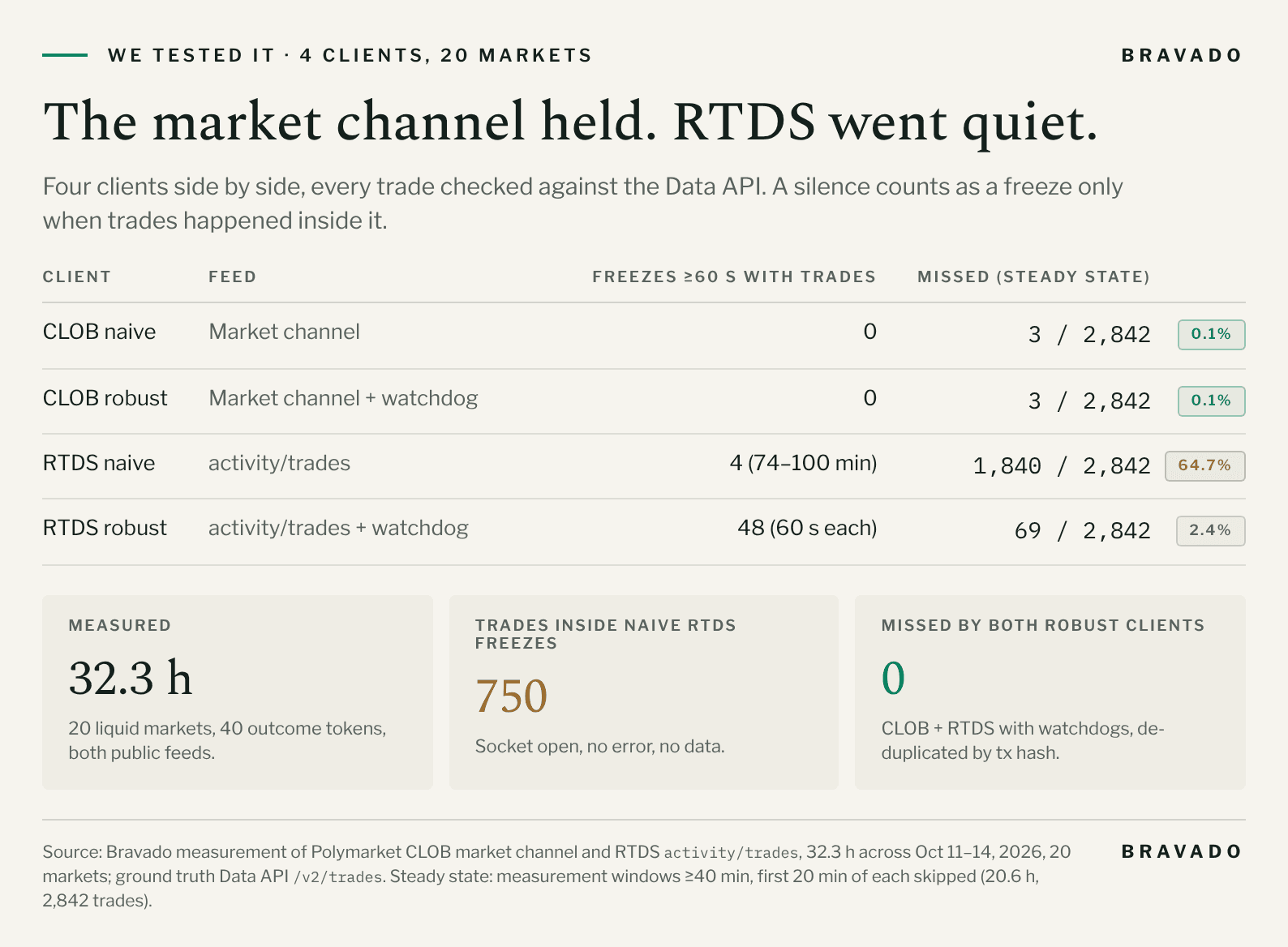
RTDS naive | 4, lasting 74–100 min each | 1,840 of 2,842 (64.7%) |
RTDS robust | 48 caught by the 60 s watchdog | 69 of 2,842 (2.4%) |
"Steady state" means measurement windows of at least 40 minutes, with the first 20 minutes of each skipped. That leaves 20.6 hours and 2,842 trades on our markets.
1. The CLOB market channel held up
Neither CLOB client had a single silence of 60 seconds or more while trades were happening, and both received all but 3 of 2,842 trades. That is 32 hours of evidence, not a guarantee.
2. RTDS connections go silent without closing
Without a watchdog, the RTDS client sat on a dead subscription four times, for 74 to 100 minutes each, while 750 trades happened on our markets. The other RTDS connection was receiving data at the same moments, so these were stalls on individual connections, not an outage.

3. A watchdog helps, but it still leaks
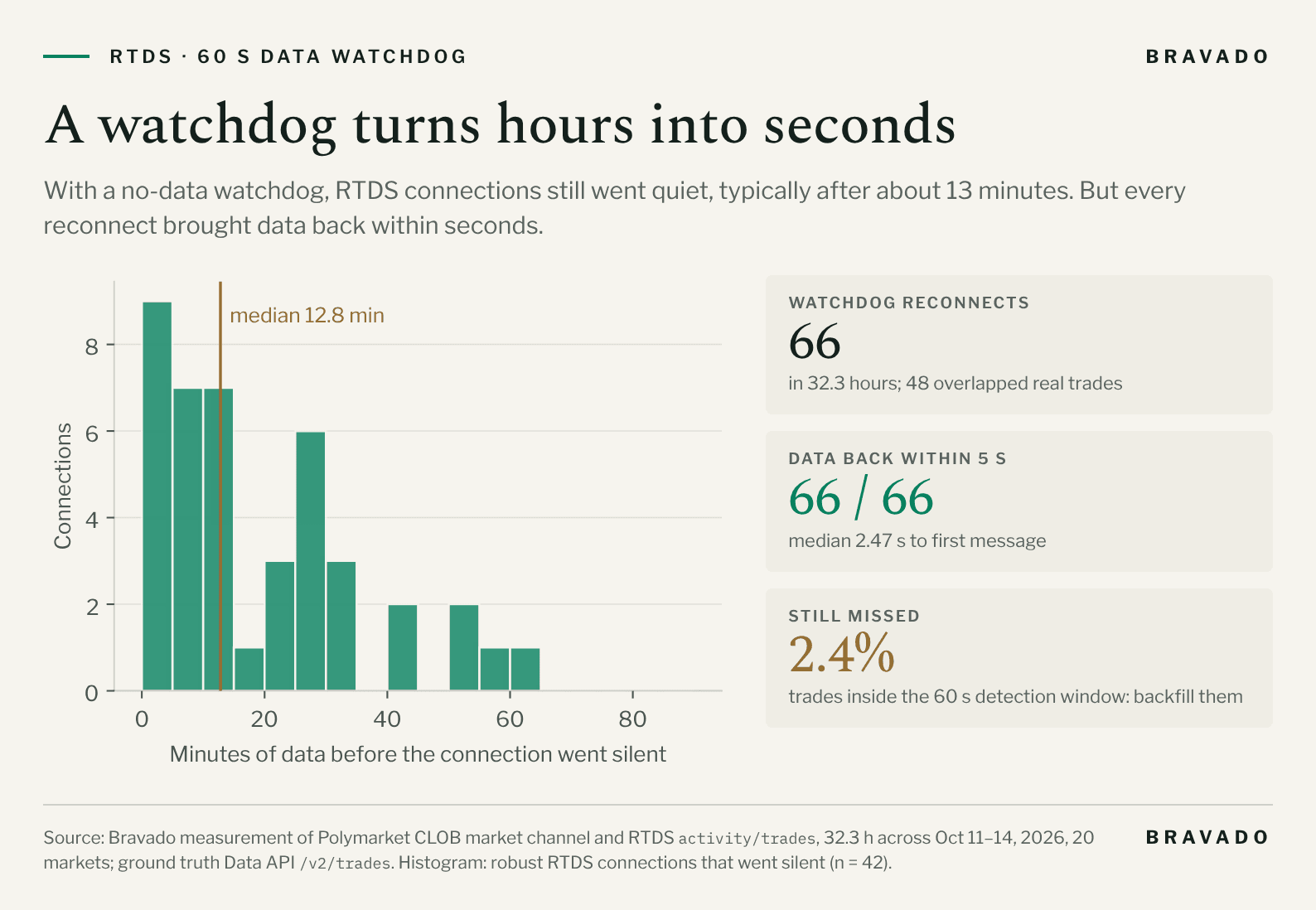
With a 60-second no-data watchdog, the RTDS client reconnected 66 times in 32.3 hours, and 48 of those silences overlapped real trades on our markets. Connections ran for a median of about 13 minutes before going quiet. After every reconnect, data was flowing again within 5 seconds (median 2.5 s). The client still missed 2.4% of trades: the ones inside each detection window.
4. Limits of the test
The 32 measured hours are not one continuous run, and many came in short windows, so we don't quote per-day rates as precise. We tested 20 liquid, long-dated markets and the unfiltered RTDS trade topic. We did not test filtered subscriptions, PolyBolt, or orders_matched.
What does it take to handle freezes yourself?
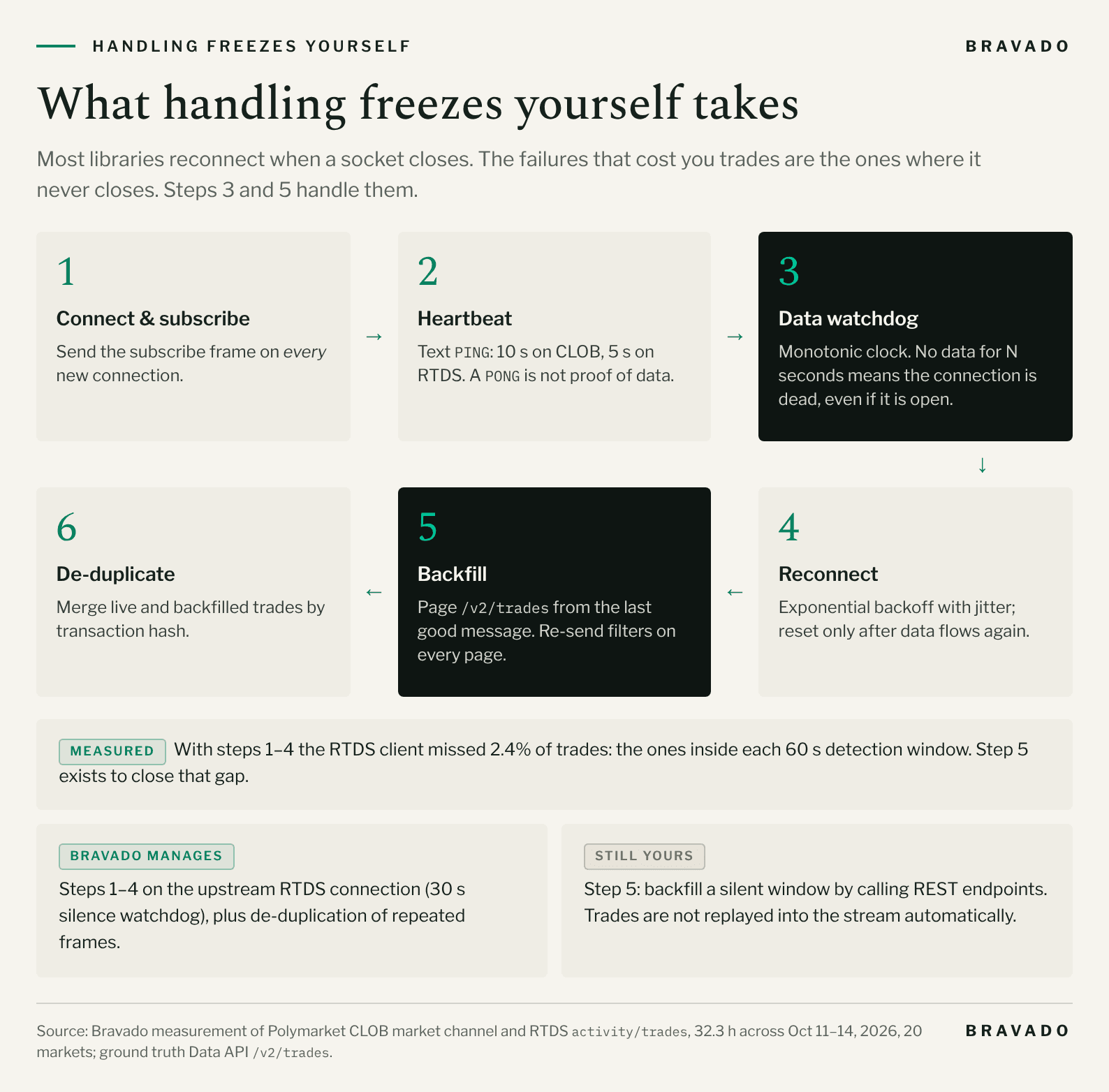
Handling this properly takes more than a reconnect loop. A production client needs every piece in the table below.
Piece | Why it matters |
|---|---|
Resubscribe on every connection | A subscription does not survive a reconnect |
Documented heartbeat | Text |
Data watchdog | The only reliable signal of a frozen subscription is missing data |
Reconnect with backoff | Recover without hammering the server |
REST backfill | Fetch trades from |
De-duplication | Merge live and backfilled trades by transaction hash |
Monitoring | Know when the feed is stalling more than usual |
The core piece is the watchdog. Here is a compact Python version for the RTDS trade stream (pip install websockets):
Two notes. First, the watchdog runs on time.monotonic(), so clock adjustments can't trip it. Second, gap_start is the time of the last good message, which is where your REST backfill should start. When you page /v2/trades for that backfill, send condition= again with every cursor. The Data API docs say the cursor carries only its position in the feed, so a bare cursor returns the global trade feed.
None of this is exotic, but it is code you have to write, test and keep running. The work adds up when you need every trade rather than most of them, when you track the whole market (the RTDS stream runs to tens of trades per second at busy times), or when your workers get recycled by autoscaling or spot instances.
How does Bravado handle the connection layer?
Bravado's Data API and WebSockets take the connection layer off your hands, and leave the gap-filling to you on your own terms.
What you'd build yourself | What Bravado provides today |
|---|---|
RTDS connection, heartbeat, resubscribe | Managed upstream connection, resubscribed on every reconnect |
Data watchdog | 30-second silence watchdog with automatic reconnect |
De-duplication around reconnects | Repeated frames de-duplicated before they reach you |
Something to show on connect | The last ~200 trades, sent when you connect |
Order-book connections | Order books relayed from Polymarket's CLOB market channel |
REST backfill | REST endpoints you call yourself to check or rebuild a window |
A managed RTDS connection. The Live Trades WebSocket relays Polymarket's RTDS trade stream, with every fill enriched with the trader's name and wallet. On our side, the upstream connection runs a 30-second silence watchdog and reconnects and resubscribes automatically. Repeated frames around a reconnect are de-duplicated before they reach you.
A short buffer on connect. When you connect, you get the last ~200 trades first, so your screen isn't empty. At busy times that covers only a few seconds. It is not a replacement for a backfill.
Order books. Live order books are relayed from Polymarket's CLOB market channel. See the Market Data overview for the full set.
REST endpoints for your own backfill. The historical data and Trader Data API endpoints cover wallet trades, price history and volume history. Call them to check or rebuild a window after an interruption.
One API across venues. The same keys and conventions cover Polymarket and Predict.fun.
Simple pricing to start. The evaluation plan includes 5,000 API credits a month, and Data API requests cost 1 credit each. The API credits page lists costs per product.
What Bravado does not do is make freezes impossible or fill gaps automatically. If the upstream goes quiet, the watchdog reconnects within about 30 seconds, and trades inside that window are not replayed into the stream. Keep a light watchdog and a backfill path on your side. The difference is that you no longer own the upstream connection itself.
Example: a bot watching Bitcoin up/down markets
Polymarket runs rolling Bitcoin "Up or Down" markets on 5-minute, 15-minute and hourly windows. Each one resolves on Chainlink's BTC price over its window, and the event slugs look like btc-updown-15m-<start epoch>. A bot that watches the 15-minute markets lives on trade flow. If its connection goes silent, three things go wrong at once:
Stale signal. The last price it saw might be minutes old, and in a 15-minute market that can be most of the window.
Missed fills. Trades it never received never enter its volume or flow numbers.
Wrong position view. If it tracks its own wallet's fills from the stream, it can think it is flat when it isn't.
With Bravado's Live Trades WebSocket, the upstream connection, the 30-second watchdog, reconnects and de-duplication are handled for you. The route has no subscription filter, so the bot filters on eventSlug itself:
The bot still checks for gaps itself. The snapshot on connect holds only the last 200 trades across all of Polymarket, which is a few seconds at busy times, and missed trades are not replayed. If the snapshot doesn't reach back to the bot's last trade, it backfills from REST before acting. If the bot also needs depth, it can pass each assetId to the authenticated order-book feed.
Conclusion
A Polymarket WebSocket that is open is not necessarily one that is working. In our 32-hour test, the CLOB market channel held up well. RTDS trade connections regularly went silent without closing, and one stayed silent for 100 minutes while hundreds of trades went by. Handling that yourself means a watchdog, reconnects, resubscribes, REST backfill and de-duplication, all running and monitored.
If you'd rather not run that layer, Bravado's Data API and WebSockets give you a managed connection with a silence watchdog, de-duplicated trades, order books, and REST endpoints for your own backfill. The quickstart takes a few minutes, and the evaluation plan includes 5,000 API credits a month. For more on Polymarket's APIs, see our guides to the Polymarket Data API v2 and calculating Polymarket PnL.
Read more blogs
Trading insights, market analysis, and strategies for Polymarket prediction markets.


